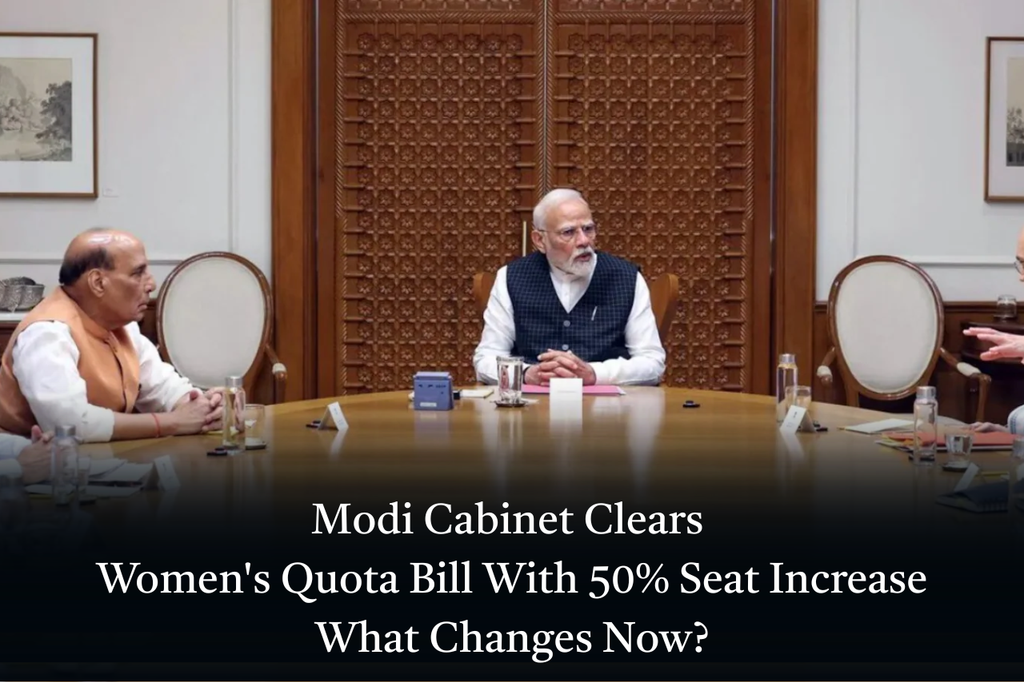
India has taken another major step towards implementing women’s reservation in Parliament and state legislative assemblies. The Union Cabinet, chaired by Prime Minister Narendra Modi, has approved a fresh constitutional amendment proposal that aims to increase the number of Lok Sabha seats by 50% across every state and Union Territory. The move is designed to make the 33% women’s reservation operational ahead of the 2029 Lok Sabha elections.
The revised proposal also seeks to address concerns raised by several regional parties, particularly those from southern India, over the possible impact of delimitation on their political representation. Under the proposed arrangement, the relative share of Lok Sabha seats among states would remain protected until 2051.
However, Cabinet approval does not mean the proposal has become law. The constitutional amendment must still pass through Parliament with the required special majority and complete the necessary constitutional process.
Here is what the proposed changes mean for India’s political system, women’s representation and the future of parliamentary elections.
What Has the Modi Cabinet Approved?
On November 27, 2026, the Union Cabinet cleared a fresh constitutional amendment proposal linked to women’s reservation and delimitation. The proposal seeks to increase the number of seats in the Lok Sabha and state legislative assemblies by 50% through a delimitation exercise.
The proposed Constitution (One Hundred and Thirty-Second Amendment) Bill, 2026, is intended to facilitate the implementation of the 33% reservation for women in elected legislatures. It also proposes raising the maximum strength of the Lok Sabha to 850 members.
The revised proposal is significant because it introduces a uniform 50% increase in seats for every state and Union Territory, rather than allowing the distribution of seats to change according to population growth alone.
According to reports, the government hopes that this formula will address concerns raised by regional parties and improve the chances of the legislation passing in Parliament.
The proposal is expected to be taken up during the special sitting of Parliament beginning November 30, 2026.
What Does the 50% Increase in Lok Sabha Seats Mean?
The biggest change in the revised proposal is the plan to increase the number of parliamentary constituencies by 50% across states and Union Territories.
At present, the Lok Sabha has 543 elected seats. Under the proposed formula, each state’s existing allocation would increase by half, subject to the constitutional framework and the proposed upper limit.
For example, if a state currently has 40 Lok Sabha seats, a 50% increase would take its allocation to approximately 60 seats.
The proposal is intended to increase representation without reducing the relative share of any state in the Lok Sabha.
The maximum strength of the Lok Sabha is proposed to rise to 850 members. The final number of seats would depend on the delimitation exercise and the application of the new formula.
This expansion could make the Lok Sabha larger and provide more constituencies for political representation across the country.
It is important to understand that the 50% increase does not mean that women will receive 50% reservation. The women’s reservation remains one-third, or approximately 33%, of seats covered by the law.
How Will the 33% Women’s Reservation Work?
The 33% women’s reservation was originally provided for under the Constitution (106th Amendment) Act, 2023, also known as the Nari Shakti Vandan Adhiniyam.
The law provides for reserving approximately one-third of seats for women in the Lok Sabha, state legislative assemblies and the Delhi Legislative Assembly. It also includes seats reserved for women belonging to Scheduled Castes and Scheduled Tribes.
However, implementation was linked to a future Census and a subsequent delimitation exercise. This meant that the reservation could not immediately be applied to elections.
The fresh proposal aims to change the implementation framework so that the reservation can be operationalised after the required delimitation exercise.
If the legislation is passed and the process is completed as planned, the government aims to implement women’s reservation in time for the 2029 general elections.
The proposed framework also provides for women’s reservation for 15 years, with the rotation of reserved constituencies to be determined under the relevant law.
This could create new opportunities for women to contest elections and participate directly in national and state-level decision-making.
Why Has the Government Proposed a 50% Seat Increase?
One major challenge surrounding delimitation is the concern that states with slower population growth could lose their relative political representation.
Southern states such as Tamil Nadu, Kerala, Karnataka and Andhra Pradesh have raised concerns about a population-based redistribution of parliamentary seats.
These states have generally performed better in population stabilisation compared with several northern states. They have argued that reducing their relative representation because of lower population growth could unfairly penalise their development and family-planning efforts.
The revised proposal attempts to address this concern by increasing the number of seats in every state by the same percentage.
In addition, the government proposes freezing the relative allocation of Lok Sabha seats among states until 2051. This is intended to provide greater certainty about the balance of representation between states.
The move could make it easier for regional parties to support the women’s reservation legislation while protecting their states’ political influence.
What Is Delimitation and Why Is It Important?
Delimitation refers to the process of redrawing the boundaries of electoral constituencies and determining how many seats each area should have.
The purpose is to ensure that electoral constituencies provide fair representation to the population.
In India, parliamentary seat allocation between states has remained largely frozen based on the 1971 Census framework. The proposed legislation seeks to introduce a new arrangement while protecting the relative share of states.
Under the reported plan, the increased constituencies would be demarcated using the 2011 Census data. The proposed freeze on the inter-state allocation of seats would continue until the relevant Census figures after 2051 are published.
A Delimitation Commission would undertake the constituency-related exercise after the necessary legislation is passed.
The process is important because it will determine the geographical boundaries of constituencies and how voters are represented in the expanded Lok Sabha and state assemblies.
The government has also proposed a 50% increase in the strength of state legislative assemblies, subject to a maximum limit of 650 seats.
What Changes Could Women See in the 2029 Elections?
If the proposed legislation becomes law and the implementation process is completed on time, the 2029 general elections could see a significant increase in the number of women candidates contesting reserved constituencies.
The expansion of parliamentary seats could create additional opportunities for women to enter electoral politics.
A one-third reservation would mean that approximately one out of every three seats covered by the provision would be reserved for women. The exact number would depend on the final seat strength and the delimitation process.
The impact could extend beyond the Lok Sabha. State legislative assemblies are also covered by the women’s reservation framework.
More women in elected positions could improve representation in discussions involving education, healthcare, employment, safety, infrastructure and social welfare.
However, reservation alone cannot guarantee equal political participation. Women candidates will also need access to party leadership, campaign resources, political networks and opportunities to hold important positions.
What Happens Next? Will Parliament Pass the Bill?
The next major step is consideration of the legislation in Parliament.
The special sitting is scheduled to begin on November 30, 2026, with the Lok Sabha meeting on November 30 and December 1, and the Rajya Sabha meeting on December 2 and 3.
Since the proposal involves a constitutional amendment, it requires a special majority in both Houses of Parliament. It must receive the support of at least two-thirds of members present and voting, as well as a majority of the total membership of each House.

The amendment will also require ratification by at least half of the state legislatures because it affects constitutional provisions relating to the representation of states.
The earlier constitutional amendment proposal introduced in April 2026 failed to secure the required two-thirds majority in the Lok Sabha. The revised proposal now attempts to address some of the concerns that contributed to that setback.
The government’s ability to secure support from regional parties and opposition MPs will therefore be crucial.
Could the New Proposal Change India’s Political Balance?
The proposed 50% expansion could have a long-term impact on India’s political landscape.
A larger Lok Sabha would mean more elected representatives and potentially more constituencies for voters. It could also change election campaigning, political alliances, and the distribution of parliamentary responsibilities.
For southern states, the proposed protection of their relative share matters especially. It seeks to ensure that their representation does not decline simply because population growth has differed across regions.
For women, the legislation could create a major opportunity to participate in national politics through a constitutional reservation.
At the same time, the proposal raises important questions about the practical functioning of a larger Parliament, the cost of expanding legislative institutions and the transparency of the delimitation process.
The success of the reform will depend not only on passing the constitutional amendment but also on implementing the new constituency boundaries fairly.
Leave a Reply