
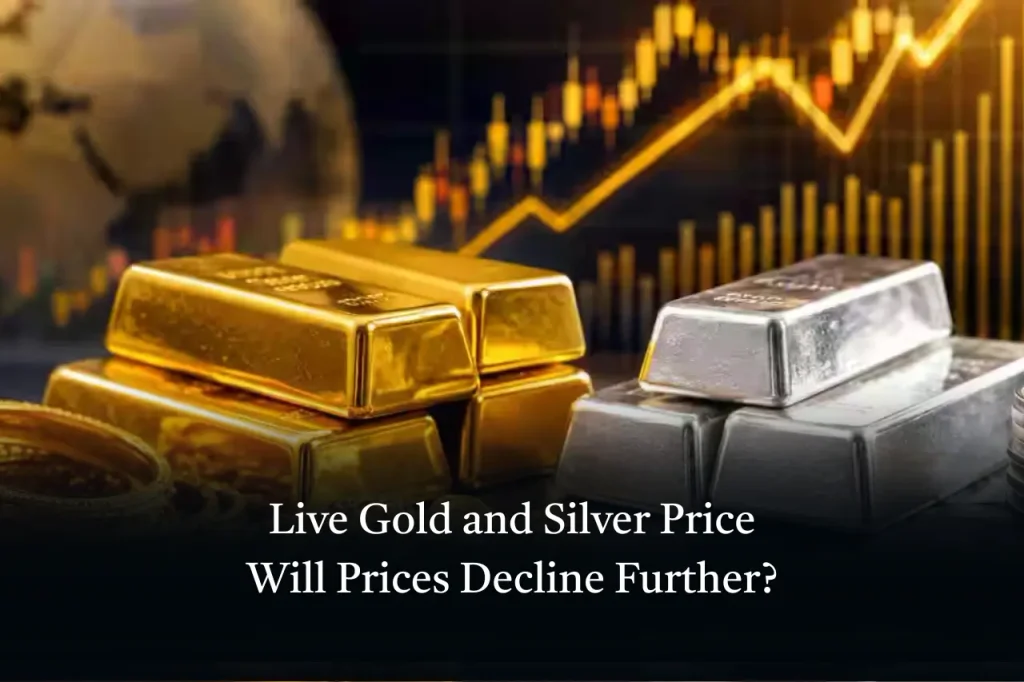
Gold and silver prices have witnessed a sharp decline in the Indian commodity market, creating uncertainty among investors and buyers. Gold prices dropped below ₹1.22 lakh per 10 grams, while silver prices plunged more than 6.3% in a single trading session. The sudden fall has raised an important question: Is this the beginning of a bigger correction, or could precious metal prices recover in the coming days?
The decline comes amid growing concerns about global economic conditions, a stronger US dollar, rising bond yields and expectations surrounding the US Federal Reserve’s interest rate decisions. Both metals have experienced significant volatility, leaving investors wondering whether they should buy at lower levels or wait for further price corrections.
Let’s look at the reasons behind the recent fall and what could happen next.
Gold Prices Fall Below ₹1.22 Lakh
Gold prices came under significant selling pressure on November 20, 2026. According to market reports, MCX gold futures were trading around ₹1,21,663 per 10 grams, registering a decline of approximately 4.54%.
The sharp correction has attracted attention because gold is traditionally considered a safe-haven investment during periods of economic uncertainty. However, even safe-haven assets can experience substantial declines when investors adjust their portfolios or move towards other financial assets.
The stronger US dollar and changing expectations about US monetary policy have contributed to the recent weakness in gold prices.
For Indian buyers, lower gold prices could provide some relief, particularly for people planning jewellery purchases or long-term investments.
Silver Prices Sink 6.3% in a Single Session
Silver experienced an even sharper decline than gold.
MCX silver futures fell approximately 6.36% to around ₹1,47,464 per kilogram during the November 20 trading session.
Silver is generally more volatile than gold because its price is influenced by both investment demand and industrial consumption. It is widely used in electronics, solar panels, electrical equipment and other industrial applications.
When investors become cautious about economic growth, concerns about future industrial demand can put additional pressure on silver prices.
The latest decline has therefore raised questions about whether silver could experience further losses before finding a stable support level.
Why Are Gold and Silver Prices Falling?
Several global factors are contributing to the recent weakness in precious metals.
1. Stronger US Dollar
One of the biggest factors affecting gold and silver prices is the movement of the US dollar.
Gold and silver are internationally traded in US dollars. When the dollar strengthens against other currencies, precious metals become relatively more expensive for buyers using those currencies.
This can reduce international demand and create downward pressure on prices.
The US dollar index has been trading near a 19-month high, making it difficult for gold and silver to recover.
2. Expectations of Higher US Interest Rates
The US Federal Reserve’s monetary policy is another important factor influencing precious metal prices.
Investors are closely monitoring inflation data and signals from Federal Reserve officials to understand the future direction of interest rates.
Higher interest rates generally make interest-bearing investments, such as government bonds, more attractive compared with gold and silver.
This is because precious metals do not generate regular interest income.
If the Federal Reserve maintains a tighter monetary policy or signals further rate increases, gold and silver could face additional pressure.
3. Rising Bond Yields
Higher US Treasury bond yields have also contributed to the recent decline.
When bond yields increase, investors may shift some of their money from non-interest-bearing assets into investments that offer regular returns.
This can reduce demand for gold and create further selling pressure.
4. Profit Booking by Investors
Gold and silver had experienced significant price movements earlier in 2026.
After strong rallies, some investors may decide to book profits and reduce their exposure to precious metals.
Large-scale selling by institutional and speculative investors can accelerate price declines, particularly when market sentiment becomes negative.
How Much Further Can Gold Prices Fall?
The next important question is whether gold prices could decline further.
According to market analysts cited in recent reports, gold is approaching important technical support levels.
The ₹1,22,000–₹1,22,800 range has been identified as an important support zone in the near-term market outlook. A decisive break below this range could open the possibility of gold moving towards ₹1,18,000–₹1,19,000.
However, these levels are technical estimates rather than guaranteed price targets.
If buying interest returns and international market conditions improve, gold could also experience a short-term recovery.
Investors should closely monitor the US dollar, Treasury yields and Federal Reserve announcements before making decisions.
Can Silver Prices Fall Below ₹1.40 Lakh?
Silver is currently facing greater volatility than gold.
Market analysts have identified the ₹1,48,000–₹1,50,000 range as an important near-term support zone. If silver breaks below this range decisively, the next potential support could be around ₹1,40,000–₹1,42,000 per kilogram.
However, silver’s industrial demand could also influence its recovery.
Strong demand from solar energy, electronics and other industrial sectors may provide support over the longer term.
On the other hand, concerns about global economic growth could continue to affect silver prices in the short term.
Should You Buy Gold and Silver at Lower Prices?
The recent correction may appear attractive to people who have been waiting for an opportunity to purchase gold or silver.
However, investors should remember that a sudden price decline does not automatically mean the market has reached its lowest point.
Here are a few things buyers should consider:
- Avoid investing everything at once: Consider purchasing in smaller amounts over a period of time rather than making one large investment.
- Watch market trends: Monitor international gold prices, the US dollar and Federal Reserve policy decisions.
- Understand your investment goals: Physical gold, gold ETFs and silver investments have different costs and risks.
- Be cautious with silver: Silver can experience larger price fluctuations than gold, making risk management especially important.
- Avoid emotional decisions: Do not buy or sell simply because prices have moved sharply in one direction.
Long-term investors should focus on their financial goals and overall portfolio allocation instead of trying to predict the exact market bottom.
What Could Happen to Gold and Silver Prices Next?
The short-term outlook for precious metals remains uncertain.
The upcoming US Federal Reserve meeting in December 2026 will be an important event for global financial markets. Investors will closely watch the central bank’s comments about inflation, interest rates and future monetary policy.
If the Federal Reserve signals a tighter monetary policy, the US dollar could remain strong, potentially putting further pressure on gold and silver.
However, if inflation concerns ease or expectations of interest rate increases weaken, precious metals could regain some buying interest.
Currency movements in India will also remain important because domestic gold and silver prices are influenced by international prices and the rupee-dollar exchange rate.
Therefore, investors should be prepared for continued volatility in the coming weeks.
Final Thoughts: Will Gold and Silver Prices Fall Further?
The recent decline in gold and silver prices has created uncertainty across the precious metals market. Gold falling below ₹1.22 lakh and silver losing more than 6.3% in a single session highlight the impact of global economic developments on commodity prices.
Further declines cannot be ruled out, particularly if the US dollar remains strong and expectations of higher interest rates continue.
However, a recovery is also possible if market sentiment improves and investors return to precious metals.
For jewellery buyers, the correction may offer an opportunity to monitor prices more closely. For investors, patience and careful risk management remain important.
Rather than trying to predict the exact bottom, buyers should follow market developments and make decisions based on their individual financial goals.
Leave a Reply