
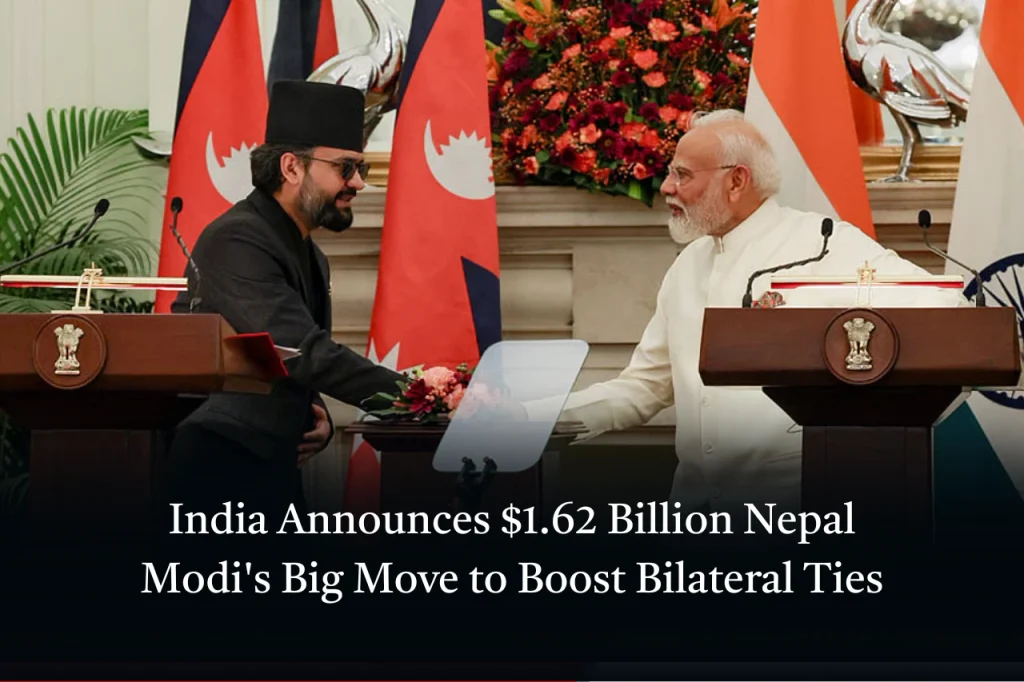
India has announced a massive $1.62 billion economic assistance package for Nepal to support the country’s recovery following devastating floods that caused widespread destruction in August 2026. The announcement was made by Indian Prime Minister Narendra Modi after meeting Nepalese Prime Minister Balendra Shah in New Delhi on November 23, 2026.
The financial package is one of India’s largest assistance commitments to its Himalayan neighbour and aims to support post-disaster reconstruction, infrastructure development and long-term economic growth. The announcement also highlights India’s efforts to strengthen diplomatic, economic and strategic relations with Nepal.
The two leaders discussed several important areas of cooperation, including energy, trade, transportation, education and regional connectivity. Their meeting comes at a significant time as Nepal works to rebuild communities affected by natural disasters and strengthen its economy.
But what exactly does India’s $1.62 billion package include? How will Nepal benefit from this financial assistance, and what does the announcement mean for India-Nepal relations?
Let’s explore the major details.
India Announces $1.62 Billion Economic Package for Nepal
On November 23, 2026, Prime Minister Narendra Modi announced that India would provide Nepal with an economic assistance package worth $1.62 billion, equivalent to approximately 240 billion Nepalese rupees.
The announcement followed bilateral discussions between Modi and Nepalese Prime Minister Balendra Shah, who was visiting India for a two-day official visit.
According to the announcement, the financial assistance is designed to help Nepal recover from the devastating floods that damaged infrastructure, homes, roads, bridges and several important economic facilities.
Modi said India’s commitment would focus on helping affected families rebuild their lives, creating new economic opportunities and improving Nepal’s ability to respond to future natural disasters.
The package is particularly important because Nepal continues to face significant reconstruction requirements following the August floods.
What Does India’s $1.62 Billion Aid Package Include?
The assistance package includes two major financial components designed to support Nepal’s recovery and development.
1. $377 Million Grant for Reconstruction
India will provide approximately $377 million in grant assistance for post-disaster reconstruction and new infrastructure projects.
Unlike a loan, grant assistance does not require repayment under normal grant conditions.
This funding is expected to support reconstruction activities and help Nepal restore essential infrastructure damaged by the floods.
Important areas of focus include rebuilding infrastructure and supporting communities affected by the disaster.
2. $1.24 Billion Line of Credit for Energy Projects
The second major component is a $1.24 billion line of credit dedicated to energy-sector projects.
Nepal has considerable hydropower potential because of its Himalayan rivers. However, the recent floods damaged several hydropower facilities, affecting electricity generation and exports.
The financial support is expected to help strengthen Nepal’s energy infrastructure and create opportunities for future development.
The specific projects and conditions for providing assistance will be finalised through discussions between the governments of India and Nepal.
Together, these two components represent India’s commitment to supporting Nepal’s reconstruction and long-term economic development.
Why Does Nepal Need Financial Assistance From India?
Nepal experienced devastating floods in August 2026 that caused enormous damage to infrastructure and communities.
According to Reuters reporting, the disaster killed approximately 1,500 people, while another 5,200 were reported missing and presumed dead.
The floods destroyed or damaged roads, bridges, schools, houses and other essential infrastructure. Several communities also suffered significant economic losses.
The disaster particularly affected Nepal’s hydropower sector.
More than a dozen hydropower projects were damaged, reducing the country’s electricity generation capacity by approximately 10%.
This situation forced Nepal to suspend electricity exports and depend more heavily on India to meet domestic energy requirements.
Nepal’s reconstruction needs are substantial. Prime Minister Balendra Shah previously indicated that post-flood recovery requirements could amount to approximately 10% of the country’s gross domestic product.
Therefore, India’s financial commitment could play an important role in helping Nepal restore damaged infrastructure and strengthen its economy.
Modi and Nepal PM Balendra Shah Discuss Stronger Bilateral Relations
The announcement of the financial package was one of the major outcomes of the meeting between Narendra Modi and Balendra Shah.
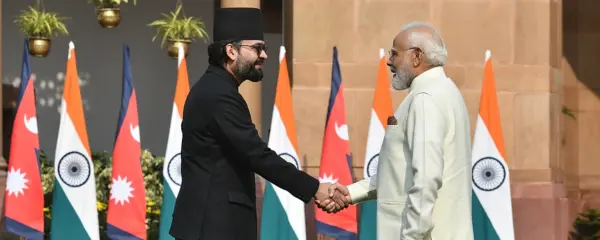
Shah’s visit was particularly significant because it was his first bilateral foreign visit since becoming prime minister in March 2026.
During the discussions, both leaders highlighted the importance of strengthening historical, cultural, economic and diplomatic relations.
Modi described India and Nepal as close neighbours with strong historical connections and shared interests.
Shah also acknowledged India’s support during difficult situations, particularly its quick response following natural disasters.
He invited Indian investors to explore business and investment opportunities in Nepal.
Both governments expressed their interest in building a stronger development partnership that could create opportunities for businesses, young people and local communities.
India and Nepal Strengthen Energy Cooperation
Energy cooperation is one of the most important parts of the India-Nepal relationship.
Nepal has significant hydropower resources, while India has a large and growing demand for electricity.
This creates opportunities for both countries to work together through hydropower development, electricity transmission and cross-border energy trade.
During the latest discussions, the two governments highlighted important hydropower projects, including the 669-megawatt Lower Arun hydroelectric project and progress towards completing the Arun-3 project.
India is also supporting petroleum infrastructure development in Nepal.
The expansion of the Motihari-Amlekhganj petroleum pipeline and plans for a new petroleum storage terminal are expected to strengthen energy security and improve the supply of essential products.
These developments could help Nepal improve its energy infrastructure while creating additional opportunities for regional energy cooperation.
New Train Service to Improve India-Nepal Connectivity
Apart from financial assistance, India and Nepal also announced developments aimed at improving cross-border transportation.
One of the major highlights was the launch of the Saryu-Kamala Express, a cross-border train service connecting Ayodhya in India with Janakpur in Nepal.
Both cities have significant religious and cultural importance.
Ayodhya is closely associated with Lord Ram, while Janakpur is traditionally associated with Goddess Sita.
The train service is expected to improve connectivity between the two countries and encourage religious tourism.
Improved transportation links could also make travel easier for visitors, pilgrims and people living near the international border.
https://www.instagram.com/p/DgFLt75I5fU
The two governments also discussed additional road, railway and border infrastructure projects to strengthen trade and transportation networks.
India further announced plans to provide Nepal with access to the Kandla port in Gujarat and Paradip port in Odisha to support its international transit trade.
This is particularly important because Nepal is a landlocked country and depends on neighbouring countries for access to international shipping routes.
India-Nepal Relations and China’s Growing Influence
India and Nepal share a long history of cultural, economic and geographical connections.
The two countries have an open border, allowing people to travel, work and maintain family and business relationships across the border.
India is Nepal’s largest trading partner and an important source of development assistance, fuel and essential commodities.
However, Nepal also maintains significant economic and diplomatic relationships with China.
China has expanded its investment and infrastructure engagement in Nepal, creating a wider regional competition for economic and strategic influence.
India’s latest $1.62 billion commitment demonstrates its interest in maintaining strong relations with Nepal through development assistance, infrastructure investment, energy partnerships and regional connectivity.
For New Delhi, a stable and economically stronger Nepal is also important for regional cooperation and security.
For Kathmandu, maintaining constructive relations with both neighbouring powers can create additional opportunities for investment, infrastructure development and economic growth.
What Does the $1.62 Billion Package Mean for Nepal’s Future?
India’s assistance could provide important support for Nepal’s economic recovery.
The reconstruction grant is expected to contribute towards restoring damaged infrastructure, while the energy-sector credit facility could help develop projects that strengthen electricity generation and regional energy cooperation.
The package could also encourage greater participation by Indian companies in Nepal’s infrastructure and energy sectors.
Improved transportation connections may support tourism, trade and business activities between the two countries.
However, the overall impact will depend on how efficiently the financial assistance is implemented.
Both governments will need to finalise individual projects, funding arrangements and implementation timelines.
Effective coordination, transparency and timely execution will be essential to ensure that the assistance reaches the sectors and communities that need it most.
Final Thoughts
India’s announcement of a $1.62 billion economic assistance package for Nepal represents a major development in regional cooperation.
The commitment comes at a difficult time for Nepal, which is still dealing with the consequences of devastating floods that damaged infrastructure, affected thousands of families and disrupted important economic activities.
Through reconstruction grants, energy-sector financing, transportation projects and broader development cooperation, India aims to support Nepal’s recovery while strengthening bilateral relations.
The meeting between Narendra Modi and Balendra Shah also demonstrates the importance both countries place on their long-standing partnership.
Although challenges remain, the latest agreement could create new opportunities for economic growth, energy cooperation, tourism and regional connectivity.
The coming months will be important in determining how effectively the announced assistance is converted into real projects and long-term benefits for the people of Nepal.
Leave a Reply