
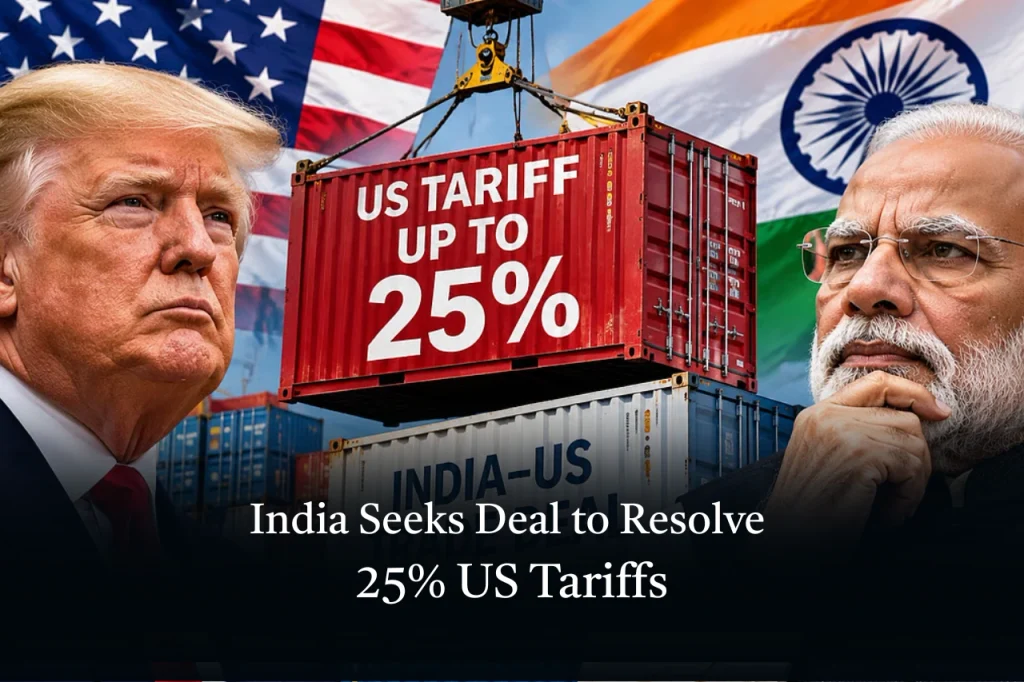
India is pushing for a diplomatic solution to the latest tariff dispute with the United States, as Washington proposes imposing additional duties of up to 25% on Indian imports. The Indian government wants all trade-related concerns to be addressed through the ongoing India-US Bilateral Trade Agreement (BTA) negotiations rather than through additional trade restrictions.
The development comes after the United States Trade Representative (USTR) completed investigations into alleged structural excess industrial capacity and production practices involving India and several other trading partners. The proposed tariffs have created fresh uncertainty for Indian exporters, manufacturers and businesses that depend on the American market.
On November 25, 2026, the US announced a proposal for tariffs of up to 25% on Indian goods. However, the US Trade Representative indicated that the rate could be reduced to 17% if India and the United States successfully conclude a trade agreement.
India’s Commerce and Industry Ministry has rejected the allegations of structural excess capacity and reiterated its commitment to resolving trade concerns through bilateral negotiations.
But what does the latest announcement mean for India? What is the current US tariff on Indian products, and who actually pays these import duties?
Let’s understand the latest developments.
India Wants to Resolve 25% US Tariffs Through Trade Deal Negotiations
India’s Commerce and Industry Ministry has said that the country remains committed to strengthening its economic relationship with the United States.
Following the latest USTR announcement, the ministry stated that India does not have structural excess capacity in any manufacturing sector.
The government also emphasised that trade-related concerns should be addressed within the framework of the ongoing bilateral trade negotiations.
India and the United States have been negotiating a comprehensive trade agreement to improve market access, encourage investment and strengthen economic cooperation.
The Indian government wants an agreement that provides competitive tariff conditions for Indian exporters compared with other major Asian economies.
India is particularly concerned about maintaining favourable access to the American market because the United States is one of its most important export destinations.
The government is expected to continue discussions with Washington to find a mutually acceptable solution.
Why Is the US Proposing 25% Tariffs on India?
The latest tariff proposal follows investigations conducted under Section 301 of the US Trade Act of 1974.
The US government has raised concerns about what it describes as structural excess industrial capacity and manufacturing practices in India.
According to Washington, certain government policies, financial support mechanisms and industrial practices could create unfair competition for American manufacturers.
The investigation has examined several factors, including manufacturing subsidies, government support, trade policies, labour protections and market access restrictions.
Industries potentially affected by the proposed measures include:
- Steel and aluminium
- Solar products
- Chemicals and petrochemicals
- Industrial machinery
- Pharmaceuticals and medical products
- Other manufactured goods
The USTR has proposed additional duties of up to 25% on Indian imports, subject to exemptions and adjustments for existing tariffs.
However, the proposal also includes a potential reduction to 17% if India concludes a trade agreement with the United States that addresses the concerns raised in the investigation.
What Is the US Tariff on India Now?
This is one of the most important questions for Indian exporters and businesses.
The US tariff situation has changed several times during 2025 and 2026.
Under the February 2026 interim trade framework, the United States had agreed to apply an 18% reciprocal tariff rate on specified Indian-origin goods.
However, following the subsequent US Supreme Court ruling affecting the earlier emergency-based tariff programme, the tariff structure changed.
The US later applied a 10% baseline tariff under a different legal framework, in addition to applicable normal product-specific import duties.
Now, the latest November 25, 2026 announcement proposes a new Section 301 tariff of up to 25% on Indian goods, with a possible reduction to 17% if a trade agreement is concluded.
Here is a simplified comparison:
| Tariff development | Rate |
|---|---|
| Earlier February 2026 trade framework | 18% |
| Later baseline US tariff | 10% |
| Latest proposed Section 301 tariff | Up to 25% |
| Proposed rate after a trade agreement | 17% |
Important: The proposed 25% rate should not be treated as an already implemented blanket tariff. The final duties will depend on the official determination, existing tariff provisions, exemptions and implementation arrangements. Normal product-specific US customs duties may also apply.
Who Will Pay the 50% Tariff on India?
Another common question is who actually pays the 50% US tariff on Indian goods.
The answer is that US importers generally pay customs duties when goods enter the United States.
If an American company imports products from India, the US importer of record is normally responsible for paying the applicable import tariff to US Customs and Border Protection.
Indian exporters do not directly pay the US government tariff simply because their products are manufactured in India.
However, the economic impact can affect both sides.
For example, suppose an American company imports Indian products worth $100,000.
If the applicable total tariff rate is 50%, the importer would generally owe $50,000 in customs duties, assuming the entire shipment is subject to that rate.
The additional cost could then be managed in different ways:
- The American importer may absorb the additional cost.
- The importer may increase prices for American customers.
- The Indian exporter may agree to reduce its selling price to remain competitive.
- The importer may look for suppliers from countries with lower tariffs.
Therefore, although US importers generally pay the tariff at the border, Indian exporters and American consumers can also experience its economic consequences.
It is also important to understand that the earlier 50% tariff figure is not the same as the latest proposed 25% Section 301 rate. The previous 50% figure related to an earlier combined tariff structure, which subsequently changed. It should not be described as the current blanket tariff on all Indian products.
How Could New US Tariffs Affect Indian Exporters?
The proposed tariff increase could create challenges for Indian companies that depend on the US market.
Higher import costs could make Indian products more expensive compared with similar products manufactured in other countries.
Some of the major export industries that could face uncertainty include:
1. Textiles and garments
India is a major supplier of clothing, fabrics and textile products to American retailers. Higher import duties could increase costs for US buyers and affect future export orders.
2. Pharmaceuticals
India has a significant pharmaceutical manufacturing industry and exports medicines to international markets. However, patented pharmaceutical articles and certain other products are among the categories identified for potential exemptions in the USTR proposal.
3. Engineering goods
Engineering products, machinery and industrial components are important parts of India’s export economy. Higher tariffs could affect their competitiveness in the United States.
4. Chemicals and petrochemicals
Indian chemical manufacturers could face additional pressure if import duties increase, particularly when competing with suppliers from other countries.
5. Solar and renewable energy products
The solar manufacturing industry could also face uncertainty as India expands its renewable energy production and international exports.
The actual impact will depend on the final tariff rates and product-specific exemptions.
Can the India-US Trade Deal Reduce Tariffs to 17%?
One of the most important developments is the possibility of reducing the proposed tariff rate from 25% to 17%.
According to US Trade Representative Jamieson Greer, Washington is prepared to apply a 17% tariff ceiling if India and the United States reach a trade agreement.
Without an agreement, the proposed rate could rise to 25%.
This gives both governments an additional reason to accelerate negotiations.
India wants a competitive agreement that protects its important domestic industries while improving access to the American market.
Some of the major discussion areas include agricultural imports, industrial products, market access, manufacturing policies and non-tariff trade barriers.
India has also maintained its position on sensitive sectors such as dairy and genetically modified agricultural products.
The final agreement will need to balance the economic interests of both countries.
If negotiations succeed, Indian exporters could benefit from more predictable tariff conditions and improved access to the US market.
What Happens Next in India-US Trade Relations?
The coming weeks will be important for determining the future of India-US trade relations.
India is reviewing the latest USTR notification and is expected to continue discussions with American officials.
The US government will also need to consider public comments and the next steps required to finalise the proposed Section 301 measures.
Businesses will closely monitor developments because changes in tariff policy can influence export orders, investment decisions and international supply chains.
If both countries reach an agreement, the proposed 17% rate could offer some relief compared with the 25% proposal.
However, if negotiations fail, Indian exporters could face additional uncertainty and higher costs when selling products in the American market.
Final Thoughts
India’s decision to seek a resolution to the proposed 25% US tariffs through the bilateral trade deal framework highlights the importance of maintaining strong economic relations with Washington.
The latest tariff proposal has created uncertainty for Indian exporters, but the possibility of a 17% rate following a successful trade agreement provides an opportunity for negotiations.
It is important to remember that US importers generally pay customs duties at the border, although the economic burden can also affect exporters and consumers.
For now, India’s priority is to secure a fair and competitive trade agreement that protects domestic industries while maintaining access to one of its largest export markets.
The outcome of the ongoing negotiations could play an important role in shaping India-US economic relations and international trade during the coming months.
Leave a Reply